World Aerobiology 2024: deadline for abstract submission extended to 1st of March!
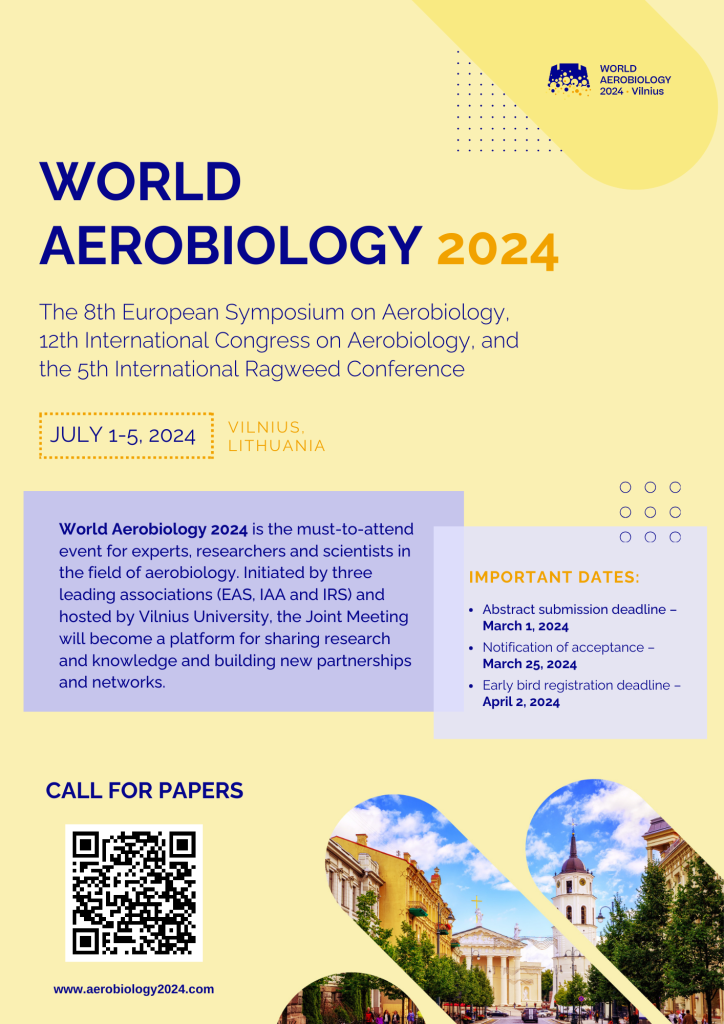
The International Ragweed Society is announcing grants to promote the participation of researchers in the conference “World Aerobiology 2024: The 8th European Symposium on Aerobiology, the 12th International Congress on Aerobiology and the 5th International Ragweed Conference”, which will be held in Vilnius (Lithuania) on July 1-5, 2024.
When applying for the grant, priority is given for Early Career Researchers who are individual members of the IRS and come from low-income countries.
Applicants must be present at the conference, and present a talk or a poster, thus submitting an abstract.
The International Ragweed Society offers five grants of 600 Euros each.
Grants will be awarded immediately after the conference.
Applicants have to submit a grant application with the following complementary documents:
1. Motivation letter (not exceeding one page).
2. Abstract of your oral or poster presentation
3. Short CV (not exceeding one page)
4. Support letter (not exceeding half a page) from an IRS member (having paid the 2023-2024 IRS membership fee).
Application procedures: all the documents must be sent by 16th of February to the IRS President László Makra (makralaszlo@szte.hu ), using the email Subject: World Aerobiology 2024 Application_last name (i.e. World Aerobiology 2024 Application_Makra).
For getting IRS membership for the 2023-2024 period, the membership form is as follows:
https://
To download the application form, please click here.
The International Ragweed Society is pleased to announce the start of regular sessions “Let’s talk about Ambrosia!”. Stay updated!
“Let’s talk about Ambrosia!” are short online conferences that aim to share between all persons interested in this plant knowledge about all aspects of vital ragweed functions, its impact and means of control.
The procedure is simple: a respectful speaker presents his/her project, work or research outcomes concerning Ambrosia species during 15 min. Next 15 minutes the public can address questions to the speaker on his presentation.
And don’t forget: you can be a speaker too!
If you would like to present your ragweed-related work or project to the community, please contact: irs.ragweed@gmail.com with a short summary of your presentation proposal.
If you want to participate to the next session, please complete the following form to receive the link : https://forms.gle/ANVQsJ2zgRrbt9HC7
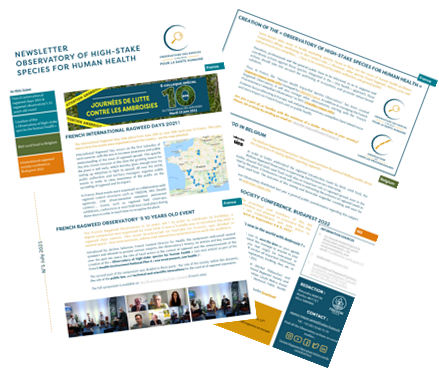
Please find the issue of September 2023 of the French observatory Letter on our website, espece-risque-sante.info : click here to consult it
This newsletter aims to provide general and scientific information on the latest news concerning ragweed species and other high-stake species for human health. In this issue :
If you know anyone who might be interested in this newsletter, please share them the link ! They also can contact us (especes-risque-sante@fredon-france.fr ) and we will send them the next issue (just a few issues are in English each year).
EAS and IAA decided to exceptionnally combine the ICA, originally planned in Worcester in 2022, with the ESA scheduled in 2024 in Vilnius. IRS will also join to organize during this time the 5th IRC.
The new official name of this event is:
World Aerobiology 2024:
The 8th European Symposium on Aerobiology, the 12th International Congress on Aerobiology and the 5th International Ragweed Conference.
You can already check the dates on your calendar:
1-5 July 2024, Vilnius, Lithuania
For more information, please visit the official website of the event: https://www.aerobiology2024.com/